Edexcel A-Level Economics · Revision notes
3.1.2 Business Growth
What the specification covers
In our own words — not the official specification wording
The routes a business can take to get bigger, what each route gains and costs it, and what can stop a business growing at all.
- The routes a business can take to get bigger:
- Expanding using the firm's own resources rather than buying another firm.
- Joining with a firm at an earlier or later stage of the same supply chain.
- Joining with a firm at the same stage of the same industry.
- Joining with a firm in an unrelated line of business.
- What each route to growth gains a firm and what it costs:
- Expanding using the firm's own resources.
- Joining with a firm at a different stage of the same supply chain.
- Joining with a firm at the same stage of the same industry.
- Joining with a firm in an unrelated line of business.
- What can stop a business growing:
- How many customers the market can offer.
- Whether the firm can raise the money to expand.
- Whether the people who own the firm want it to get bigger.
- Rules imposed by government or regulators.
A firm can get bigger in two fundamentally different ways: by expanding its own operations, or by combining with another firm. This topic covers both routes, what each gains and costs, and why a firm that wants to grow may find it cannot.
Organic growth
Organic (or internal) growth means expanding using the firm's own resources — opening more outlets, investing in capacity, hiring more staff, entering new markets. Greggs opening further shops is organic growth.
- Advantages: it can be financed from retained profit rather than debt; the existing culture and management structure stay intact; it is lower risk, because expansion can be slowed if demand disappoints.
- Disadvantages: it is slow, it may be too slow to establish a position before rivals do, and it does not bring in the new technology, brands or expertise that buying a firm can.
Integration
Integration means growing by merger or takeover. A merger is an agreed combination of two firms; a takeover (acquisition) is one firm buying control of another, and may be resisted.
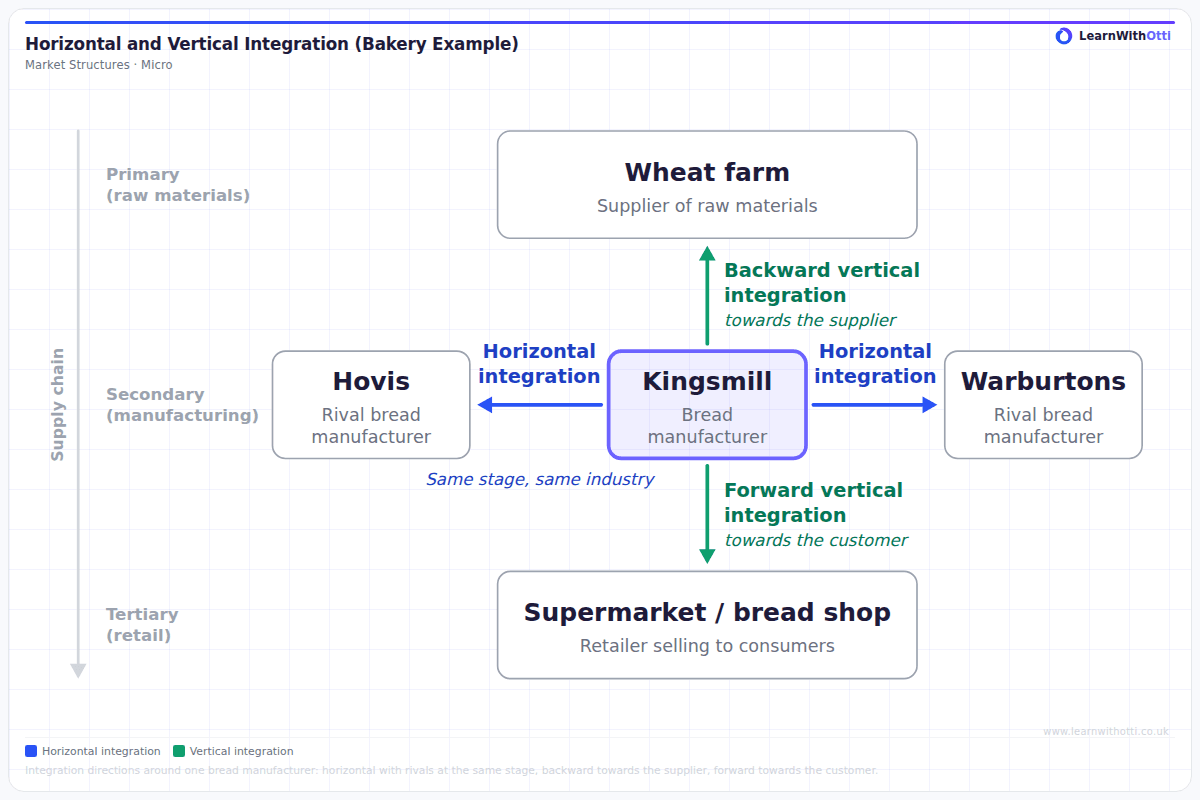
Vertical integration combines firms at different stages of the same supply chain.
- Backward vertical integration is towards the supplier: a coffee chain buying a coffee plantation.
- Forward vertical integration is towards the customer: a manufacturer buying a retail chain.
- Advantages: control over supply quality and cost, secure access to inputs or to a route to market, and the ability to raise rivals' costs by controlling a key input.
- Disadvantages: the firm takes on a business it may not understand, it loses the discipline of buying in a competitive market, and it can end up with capacity it cannot use if demand for the final product falls.
Horizontal integration combines firms at the same stage of the same industry — two supermarket chains, or two airlines.
- Advantages: rapid growth in market share, economies of scale from combined operations, and the removal of a competitor.
- Disadvantages: it attracts the attention of competition authorities, and the cultures of the two firms may not merge as easily as their balance sheets.
Conglomerate integration combines firms in unrelated markets.
- Advantages: diversification spreads risk across markets whose fortunes do not move together, and it opens entirely new revenue streams.
- Disadvantages: there are few or no synergies, and management may lack expertise in the acquired market. Many conglomerates are later broken up.
A general point applies to all three.
Evaluation: Research repeatedly finds that a large proportion of mergers fail to deliver the gains expected of them, usually because the predicted cost savings do not materialise or because integrating two organisations proves harder than the deal assumed.
Constraints on business growth
Not every firm that wants to grow can.
- The size of the market. A firm in a small or niche market runs out of customers. Growth then requires a new market rather than more of the same.
- Access to finance. Expansion needs capital. Firms without collateral, a trading record or access to equity markets may be unable to raise it on affordable terms.
- The owners' objectives. Some owners deliberately cap the size of the business to retain control, protect quality or limit their workload.
- Regulation. Competition authorities can block a merger that would substantially reduce competition, and regulated industries may face limits on market share. They can also clear a merger that looks anti-competitive. In June 2026 the CMA cleared the purchase of Hovis by ABF, the owner of Kingsmill, after an in-depth investigation. It found that Kingsmill’s bakery business had made losses for 14 years and would probably have left the market without the deal, so the merger removed little competition that would otherwise have survived.
Key idea: Diseconomies of scale act as a further practical limit: beyond a certain size, the costs of coordination can rise faster than the savings from producing more.
Key terms
| Term | Meaning |
|---|---|
| Organic growth | Expansion using the firm's own resources |
| Merger | An agreed combination of two firms |
| Takeover | One firm acquiring control of another |
| Vertical integration | Combining firms at different stages of the same supply chain |
| Horizontal integration | Combining firms at the same stage of the same industry |
| Conglomerate integration | Combining firms in unrelated markets |
| Synergy | Gains arising from combining two firms that neither could achieve alone |
Common mistakes
- Mixing up forward and backward. Backward goes towards the supplier, forward goes towards the customer. Picture the supply chain running from raw material at the top down to the shopper at the bottom.
- Assuming integration always lowers costs. Economies of scale are potential, not automatic, and many mergers do not deliver them.
- Calling any large purchase horizontal integration. The test is whether the two firms operate at the same stage of the same industry, not whether the deal is large.
- Treating constraints as reasons a firm failed. A firm choosing to stay small because its owners prefer it is not a firm that failed to grow.
How this has been examined
In the Edexcel papers indexed on this site, this topic has appeared in five formats:
- 15-mark "Discuss" data response — asked twice across 2 series (2017 to 2025)
- 12-mark "Discuss" data response — asked twice across 2 series (2022 to 2024)
- 1-mark multiple choice — asked twice across 2 series (2020 to 2022)
- 8-mark "Examine" data response — asked once (2019)
- 2-mark "Explain" — asked once (2020)
Where this goes next
The reverse decision is covered in 3.1.3 Demergers, and the objectives that drive a growth decision in 3.2.1 Business objectives. The cost consequences of getting larger appear in 3.3.3 Economies and diseconomies of scale, and the competition authorities' response to integration in 3.6.1 Government intervention.
Otti is an AI tutor built for A-Level students. Ask it anything, practise exam questions, and get instant feedback written like an examiner would give it — not just right or wrong, but why.
Get one answer marked free