Edexcel A-Level Economics · Revision notes
2.2.3 Investment (I)
Investment is spending on capital goods: machinery, buildings, vehicles, computer systems and other assets used to produce goods and services in the future. It accounts for around 19% of UK GDP, much less than consumption, but it is the most volatile component of aggregate demand. It also matters twice over, because it adds to demand now and to productive capacity later.
What counts as investment
In macroeconomics, investment means spending on new physical capital. It includes:
- firms buying new machinery, equipment and software;
- the construction of factories, offices and shops;
- a firm buying delivery vehicles for its business.
Watch out: It does not include buying shares or putting money in a savings account. Those are financial transactions that move ownership of existing assets; they are often called investment in everyday speech, but they do not create new capital.
Gross and net investment
Capital wears out or becomes outdated over time. This loss of value is called depreciation (or capital consumption).
- Gross investment is the total spending on capital goods in a period, including spending that simply replaces worn-out capital.
- Net investment is gross investment minus depreciation: the actual addition to the stock of capital.
Net investment = gross investment − depreciation
If gross investment is £50 billion and depreciation is £40 billion, net investment is £10 billion, and the capital stock grows. If gross investment were only £35 billion, net investment would be −£5 billion and the capital stock would shrink, even though firms were still spending on new machinery.
Net investment is what determines whether an economy's productive capacity is growing.
Influences on investment
The rate of economic growth
Firms invest to meet rising demand. When the economy grows quickly, firms need more capacity, so investment rises.
Key idea: This is the accelerator effect: investment depends on the rate of change of output, not its level.
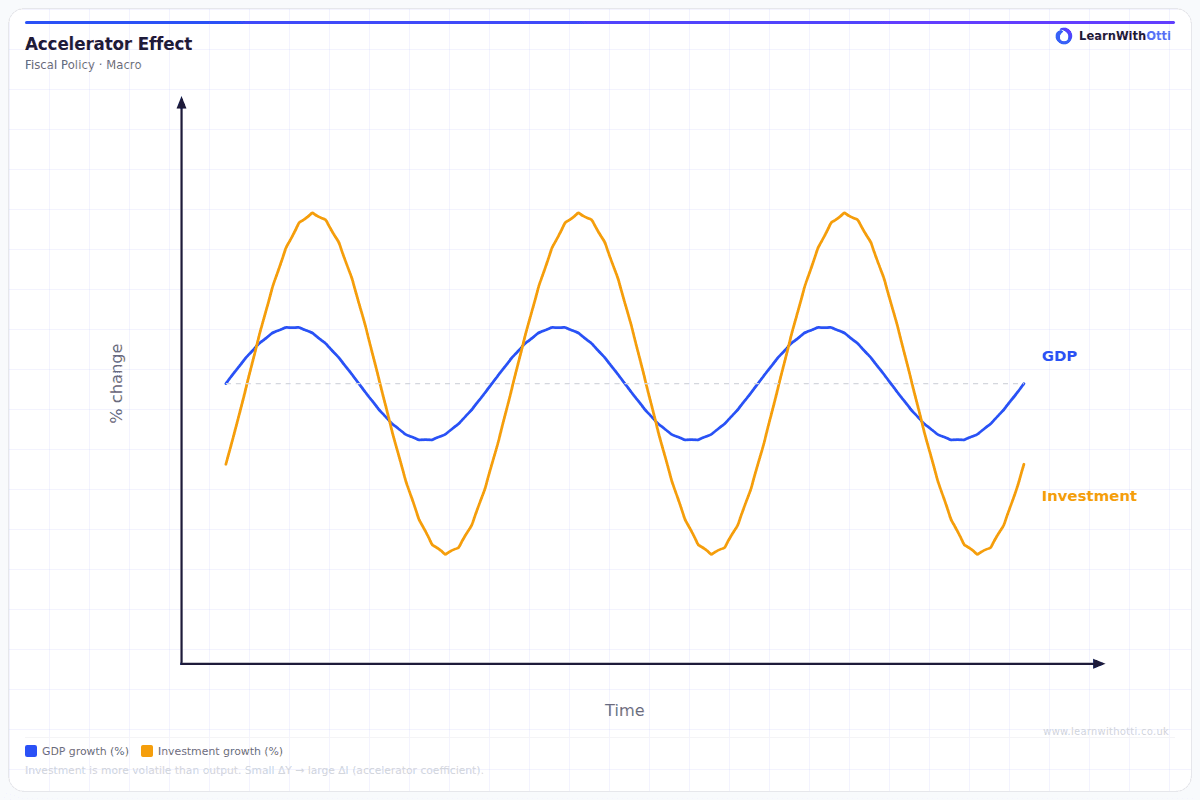
A simple example shows why investment is so volatile. A firm uses 10 machines, each lasting 10 years, so it replaces one machine a year. If demand for its output rises by 10%, it needs 11 machines: one replacement plus one new machine, so investment doubles from one machine to two. If demand then stops growing, investment falls back to one machine, a 50% drop, even though output is still at its higher level. Small changes in the growth of demand cause much larger swings in investment.
Business expectations and confidence
Investment pays off over many years, so firms must judge what demand, costs and profits will be well into the future. When firms are confident, they invest; when they are uncertain, they delay. Political uncertainty, such as a change in trading arrangements, can hold back investment for years.
Keynes and 'animal spirits'
John Maynard Keynes argued that investment decisions cannot be based purely on calculation, because the future is genuinely uncertain. Instead, they depend on animal spirits: waves of optimism and pessimism among business leaders. This helps explain why investment can rise or fall sharply without any obvious change in interest rates or profits.
Demand for exports
Firms that sell abroad invest to meet foreign demand. Strong growth in the UK's export markets, or a fall in the pound that makes UK goods cheaper abroad, encourages investment in capacity.
Interest rates
Many investment projects are financed by borrowing. A rise in interest rates makes borrowing more expensive and raises the return a project must earn to be worthwhile, so fewer projects go ahead. Even firms using their own retained profits face an opportunity cost, because the money could earn interest instead.
Access to credit
Firms need to be able to borrow, not just afford the interest. After the 2008 financial crisis, banks cut lending sharply, and many small firms could not raise finance for investment even when interest rates were very low.
The influence of government and regulations
Government can encourage investment through tax allowances that let firms deduct the cost of new capital from their taxable profits, through grants, and through its own spending on infrastructure. Regulation can work both ways: clear, stable rules support investment, while complex or frequently changing rules add costs and uncertainty that deter it.
Why investment matters
- In the short run, investment is a component of aggregate demand. A rise in investment shifts AD to the right.
- In the long run, net investment increases the capital stock and raises productive capacity, shifting long-run aggregate supply to the right.
This double role makes investment central to both the business cycle and long-run growth.
Key terms
| Term | Meaning |
|---|---|
| Investment | Spending on capital goods that will be used to produce goods and services in the future |
| Depreciation | The fall in the value of capital as it wears out or becomes outdated |
| Gross investment | Total spending on capital goods, including replacement of worn-out capital |
| Net investment | Gross investment minus depreciation |
| Accelerator | The idea that investment depends on the rate of change of output |
| Animal spirits | Keynes's term for the optimism or pessimism that drives investment decisions |
Common mistakes
- Counting financial assets as investment. Buying shares does not create new capital.
- Confusing gross and net investment. Only net investment adds to the capital stock.
- Explaining interest rates with no mechanism. The link runs through the cost of borrowing and the opportunity cost of using retained profits.
- Mentioning only the demand side. Investment also raises productive capacity in the long run.
- Describing the accelerator in terms of the level of output. It depends on the change in output.
How this has been examined
In the Edexcel papers indexed on this site, this topic has appeared in two formats:
- 4-mark "Explain" data response — asked once (2022)
- 1-mark multiple choice — asked once (2024)
Where this goes next
Investment is one of the four components in 2.2.1 The characteristics of AD, alongside 2.2.2 Consumption (C). It is an injection in 2.4.2 Injections and withdrawals, and its effect on productive capacity appears in 2.3.3 Long-run AS and 2.5.1 Causes of growth. Its volatility helps explain the 2.5.3 Trade (business) cycle.
Otti is an AI tutor built for A-Level students. Ask it anything, practise exam questions, and get instant feedback written like an examiner would give it — not just right or wrong, but why.
Get one answer marked free