Edexcel A-Level Economics · Revision notes
3.4.6 Monopsony
A monopoly is a single seller. A monopsony is the mirror image: a single buyer. Just as a monopolist can push prices up, a monopsonist can push the prices it pays down. This topic covers the conditions that create monopsony power and who gains and loses from it.
Characteristics and conditions for a monopsony
A monopsony is a market with a single buyer. In practice, the term is used for any buyer with enough power to influence the price it pays. A market with a few dominant buyers is sometimes called an oligopsony.
For a monopsony to operate:
- One buyer must account for a large share of purchases in the market, whether of a product or of labour.
- Sellers must have few alternative buyers. A supplier that can easily sell elsewhere cannot be pushed into accepting a low price.
- Sellers find it hard to leave. Specialist skills, perishable products or long-term contracts tie them to the buyer.
Examples
- The NHS employs most of the UK's doctors and nurses, so it has considerable power over their pay.
- Large supermarkets buy a large share of the output of many farmers and food producers, who have few other routes to consumers.
- A dominant employer in a small town, where workers would have to move or commute a long way to work elsewhere.
How a monopsonist uses its power
In product markets, a monopsonist can negotiate lower prices from suppliers, insist on longer payment periods, or require suppliers to pay for promotions and packaging.
Key idea: In labour markets, a monopsony employer can pay a lower wage and employ fewer workers than a competitive market would. To hire one more worker, it would have to raise the wage for all its workers, so the extra cost of hiring is higher than the wage itself.
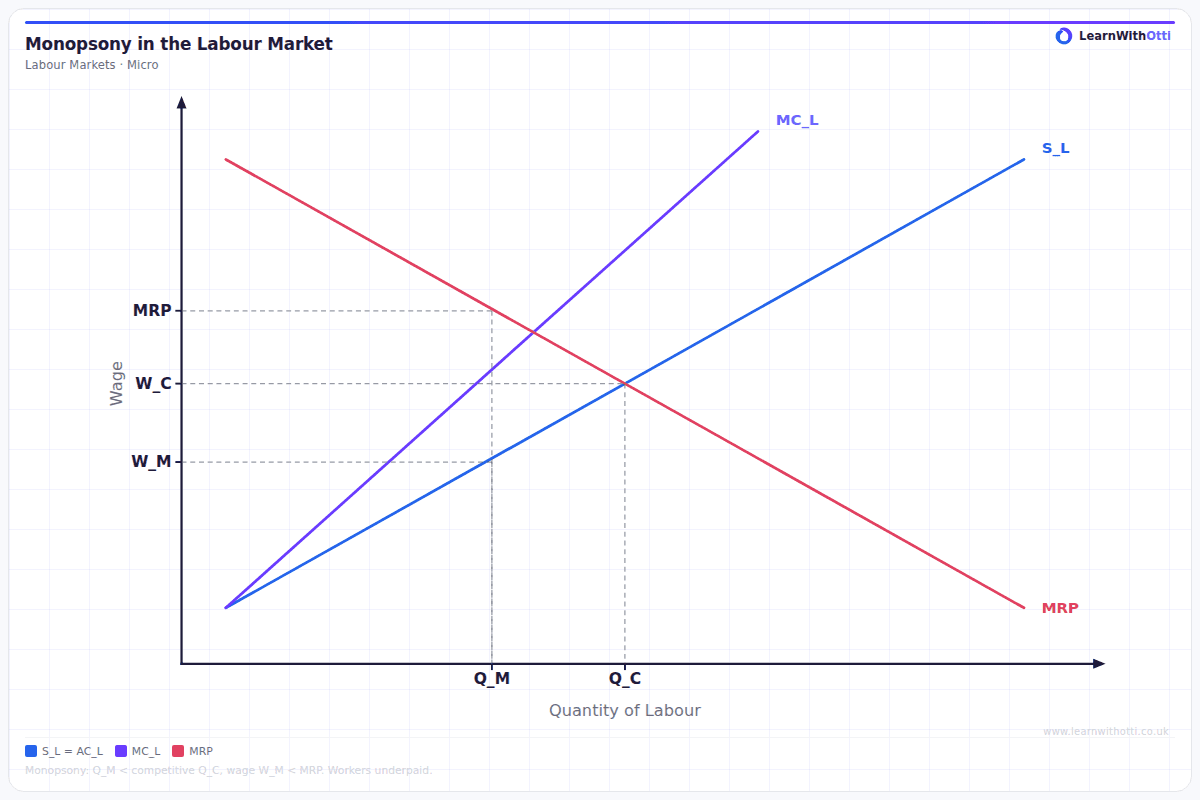
Watch out: The monopsony diagram is not technically on the Edexcel specification, so you will not be required to draw it. But using it correctly in a labour market answer is still beneficial, because it shows clearly why a monopsony employer pays a lower wage and hires fewer workers than a competitive market would.
Costs and benefits of monopsony
| Group | Possible costs | Possible benefits |
|---|---|---|
| Firms (the monopsonist) | Over-reliance on squeezed suppliers can damage quality and reliability of supply | Lower costs and higher profits; funds for investment |
| Consumers | Less choice and lower quality if suppliers cut corners or leave the market | Lower prices if the monopsonist passes on its lower costs |
| Employees | Lower wages and fewer jobs than in a competitive labour market; little bargaining power | A large employer may offer stable employment, training and a clear career structure |
| Suppliers | Lower prices, delayed payment and pressure on profit margins; some may be forced out of business | A large, reliable customer that buys in large volumes |
Evaluation: For the public sector, monopsony power can be a benefit to taxpayers. The NHS can negotiate lower prices for medicines than many individual buyers could. But holding down pay too far can lead to staff shortages, as workers leave for other sectors or other countries.
Responses to monopsony power
- Regulation can limit the abuse of buying power. In the UK, the Groceries Code Adjudicator was set up in 2013 to oversee how the largest supermarkets treat their suppliers.
- Trade unions can counter an employer's monopsony power by bargaining collectively for higher wages.
- A minimum wage can raise pay in a monopsony labour market, and in some cases may even increase employment.
Key terms
| Term | Meaning |
|---|---|
| Monopsony | A market with a single buyer, or a buyer with enough power to influence the price it pays |
| Oligopsony | A market dominated by a few buyers |
| Buying power | The ability of a buyer to push down the prices it pays |
| Groceries Code Adjudicator | The UK body that oversees how large supermarkets treat their suppliers |
Common mistakes
- Confusing monopsony with monopoly. A monopoly is a single seller; a monopsony is a single buyer.
- Assuming monopsony always harms consumers. Lower costs can be passed on as lower prices.
- Ignoring suppliers' alternatives. Monopsony power depends on sellers having few other buyers.
- Forgetting the employment effect. A monopsony employer pays less and also employs fewer workers.
How this has been examined
In the Edexcel papers indexed on this site, this topic has appeared in two formats:
- 25-mark "Evaluate" essay — asked once (2020)
- 12-mark "Discuss" data response — asked once (2017)
Where this goes next
The seller-side equivalent is covered in 3.4.5 Monopoly. Monopsony in the labour market is analysed in 3.5.3 Wage determination in competitive and non-competitive markets, and government responses to market power in 3.6.1 Government intervention.
Otti is an AI tutor built for A-Level students. Ask it anything, practise exam questions, and get instant feedback written like an examiner would give it — not just right or wrong, but why.
Get one answer marked free